How to Store Extra Bedding in a Small Bedroom
We’ve all been there. You’re changing the sheets, and suddenly an avalanche of spare comforters, mismatched pillowcases, and guest blankets comes crashing down on you. In a small bedroom, bulky bedding is the ultimate space-hog. It eats up closet shelves, monopolizes under-bed real estate, and makes your sanctuary feel more like a storage unit.
The secret to fixing this isn’t buying a massive armoire. It’s about editing your collection, compressing the bulk, and using vertical space strategically. Here is your practical, no-stress guide to storing extra bedding so it stays clean, dry, and completely out of your daily visual space.
1: The Great Bedding Edit (Before You Buy Bins)
You cannot organize your way out of having too many blankets. Before you spend a dime on storage bins, you need to edit your collection. Small rooms don’t have “extra” storage; every item must earn its footprint.
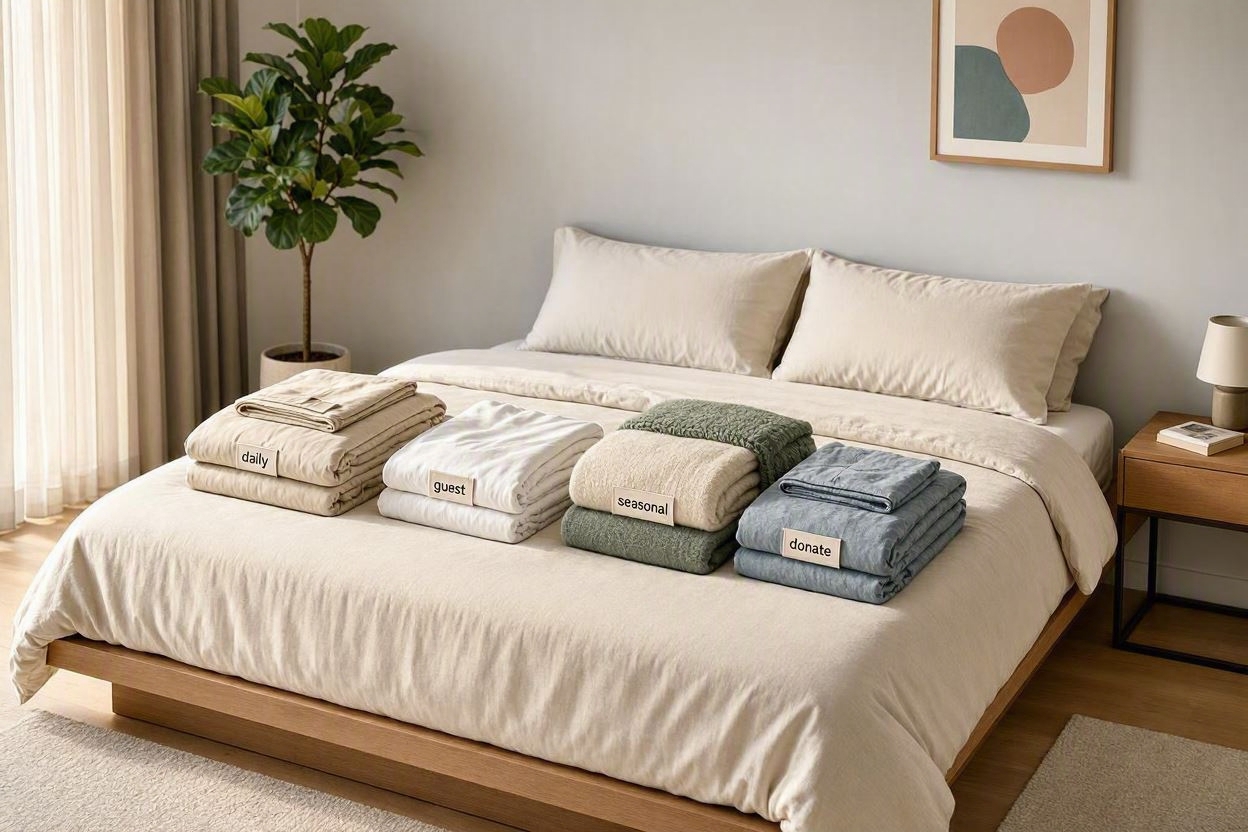
Take every spare sheet, blanket, and duvet out of your closet and sort them into four piles:
- Daily Use: The sheets currently on the bed and your everyday blanket.
- Guest-Ready: One complete, matching spare set per bed.
- Seasonal: Heavy winter comforters, flannel sheets, and extra throws.
- The “Retire” Pile: Mismatched sets, scratchy blankets, and flat pillows.
Here is a simple guideline per bed: Keep exactly two sheet sets (one on the bed, one clean spare) and one spare blanket or duvet. That’s it. If you have three sets of Queen sheets but only one Queen bed, two of those sets are just taking up valuable real estate. Donate them. Also, match every fitted sheet with its correct flat sheet and label the size. Combine all those “orphan” pillowcases into one small pouch so they stop floating around the house. Remember: your bedroom storage is not a museum for bedding you’ll never use.
2: The Master Storage Guide (Choose Your Zone)
Once you’ve edited your collection, you need to match the storage method to your specific space. In a small bedroom, the best bedding storage is usually low, high, or hidden not taking up precious floor space in the middle of the room. Store your daily spare sheets within arm’s reach (like a closet shelf or dresser drawer), and banish seasonal comforters to harder-to-reach spots (like under the bed or the top closet shelf).
Here is the ultimate cheat sheet to choosing the right solution:
| Storage Method | Best For | Space Efficiency | Protection Level | Watch Outs | Best Items to Store |
|---|---|---|---|---|---|
| Under-bed lidded bins | Small rooms, no closet space | High | High | Needs bed clearance; choose low-profile bins | Comforters, spare blankets, seasonal sheets |
| Vacuum compression bags | Maximum space saving | Very High | Medium | Not ideal long-term for down/feather; allow re-fluff time | Bulky comforters, throws (synthetic fills) |
| Closet top-shelf bins | Bedrooms with a closet | High | High | Hard to reach; use light bins with handles | Guest bedding, spare sheet sets |
| Hanging closet organizer | Tight closets | Medium | Medium | Can sag if overloaded | Sheet sets, pillowcases, lightweight blankets |
| Storage bench/ottoman | Multi-use bedrooms | Medium | High | Capacity limited; don’t overpack | Guest sets, throw blankets, extra pillows |
| Bed frame with drawers | Permanent solution | High | High | Drawer clearance needed in tight rooms | All categories (great for rotation) |
3: Under-Bed & Closet Hacks (The Heavy Lifters)
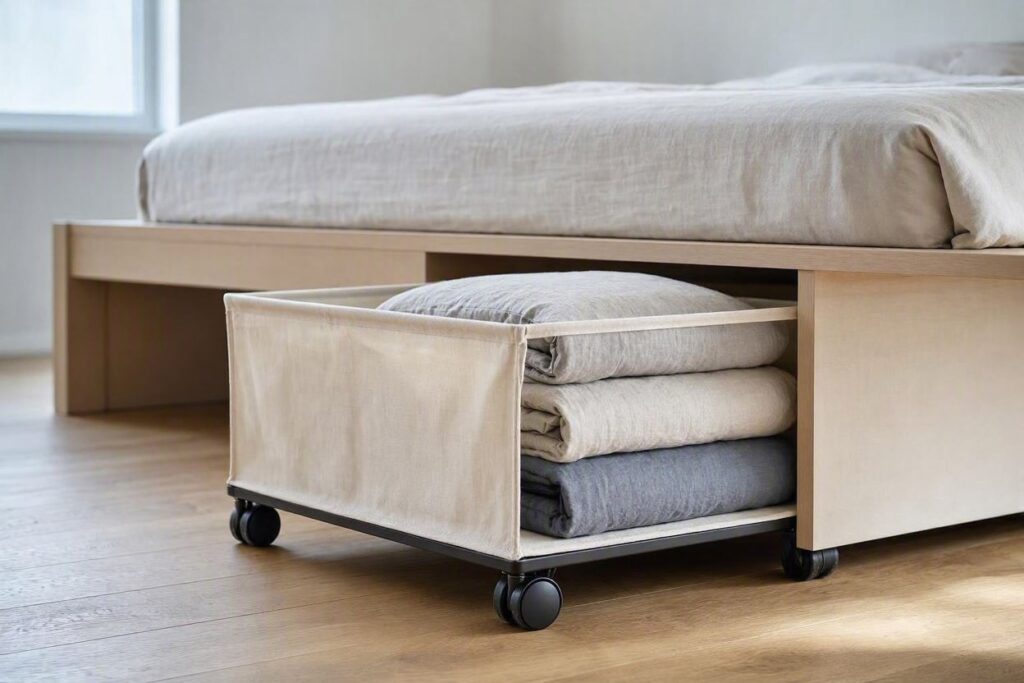
The space under your bed is often the best “extra closet” you have, but it can quickly turn into a dusty nightmare if you aren’t careful. If you have a platform bed with no clearance, don’t force it, use the top of your closet instead.
For under-bed storage, always use lidded bins. Open baskets look cute, but they let dust and pet hair settle right into your clean sheets. Low-profile bins with wheels (like the IKEA SKUBB or The Container Store’s Underbed Box) are a lifesaver because you can actually pull them out without breaking a sweat. To keep things smelling fresh, toss a cedar block or a lavender sachet inside the bin. And whatever you do, never pack damp linens away; let them air dry completely first to prevent mildew.
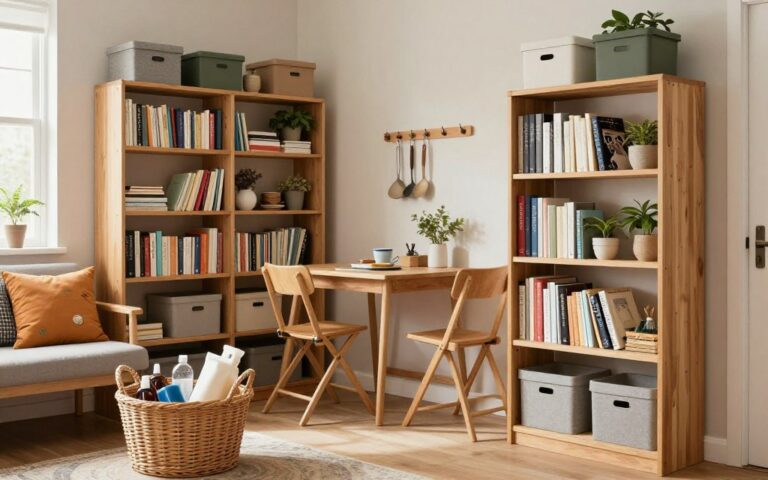
When it comes to your closet, avoid the dreaded “closet avalanche.” Soft piles of blankets slump and fall over. Instead, use 2 to 4 matching, labeled bins on your top shelf. Label them clearly: “Guest Sheets” “Winter Bedding” “Pillow Inserts” If your closet is tiny, a hanging closet organizer is a great way to use vertical air space for folded sheet sets.
Here is a pro folding trick that saves massive amounts of space: Keep each sheet set together by folding the fitted sheet and flat sheet, then wrapping them entirely inside one pillowcase from that exact set. You get one tidy, secure “bedding bundle” that stacks perfectly and never loses its matching pieces.
What about vacuum compression bags (like SpaceSaver)? They are magical for bulky synthetic comforters you won’t touch for six months. However, be careful with down or feather duvets. Long-term compression can damage the natural loft of the feathers. If you must use them for down, only compress them seasonally and give them a good shake and 24 hours to re-fluff before use.

4: Multi-Function Furniture & Keeping Things Fresh
In a small bedroom, furniture that doubles as storage is the difference between a cramped cave and a calm sanctuary.
If you have the floor space, a storage bench at the foot of the bed is perfect for holding guest sets and throw blankets. A storage ottoman in the corner can hide extra pillows, and a bed frame with built-in drawers offers high-capacity, easy-access rotation. Just make sure to measure the drawer clearance so they can actually open without hitting your dresser! Pro tip: If you use an ottoman, avoid storing heavy winter comforters in it, as the constant sitting can compress the fill over time. Stick to lighter throws and extra pillows.
But storing bedding isn’t just about space; it’s about freshness. Closed storage can trap odors. Wash all items before putting them into long-term storage. Air out your stored comforters seasonally just laying them near an open window for 30 minutes works wonders. If you are storing delicate textiles and worry about airflow, use breathable cotton canvas bags instead of plastic bins.
Finally, implement a simple rotation schedule. Swap your seasonal items twice a year (spring and fall). Do a quick “bedding reset” once a month: return stray blankets to their bins, re-stack your bundles, and check if anything needs a quick wash.

The Final Checklist
You don’t need a massive walk-in closet to keep your bedding organized. By editing your collection, using the “bundle” folding trick, and choosing the right bins for your under-bed and closet spaces, you can reclaim your bedroom. Take a deep breath, look at your newly organized closet, and enjoy the peace of mind that comes with a truly functional small space.
Before you finish, run through this quick checklist:
- Have you donated the mismatched and scratchy bedding?
- Are your daily sheets stored within arm’s reach?
- Are your seasonal comforters compressed or tucked away in lidded bins?
- Did you add a cedar block or lavender sachet to your closed storage?
Your bedroom should be a peaceful retreat, not a storage unit for blankets you’ll never use. Implement these simple steps, and you’ll never have to dig through an avalanche of linens again.